
Wrapped in a tranquil blanket of winter frost and steeped in intellectual majesty, Weimar stands as the spiritual heart of German literature, philosophy, and modern design. Known as the cradle of Weimar Classicism and the birthplace of Walter Gropius’s revolutionary Bauhaus movement, this UNESCO World Heritage town welcomes winter travelers with gas-lit cobblestone avenues, the rich savory aroma of authentic charcoal-grilled Thüringer Rostbratwurst drifting across historic market squares, and centuries of artistic genius preserved in intimate palace salons and tranquil parklands.
While summer visitors fill the tour routes of larger German metropolises, Weimar in winter offers an evocative, deeply contemplative European city break. Here, Johann Wolfgang von Goethe and Friedrich Schiller forged a golden age of enlightenment poetry and drama, while Franz Liszt composed in his piano salons and Walter Gropius founded modern 20th-century architecture. From walking through Goethe’s magnificent yellow Baroque residence on the Frauenplan and exploring the treasures of the Duchess Anna Amalia Library to savoring steaming Thuringian potato dumplings (*Thüringer Klöße*) beside roaring tavern fireplaces, a 48-hour winter weekend in Weimar delivers unmatched cultural elegance and cozy comfort.
Why You’ll Love Weimar in Winter
- Dual UNESCO World Heritage Treasures: Explore “Classical Weimar” (Goethe and Schiller residences, palaces, and parks) and the “Bauhaus and its Sites in Weimar” free of summer crowds.
- The Legendary Duchess Anna Amalia Library: Gaze upon the breathtaking three-story Rococo Hall (*Rokokosaal*), housing over one million historic volumes and antique busts under gilded vaults.
- Authentic Thuringian Gastronomy: Indulge in EU-protected charcoal-grilled *Thüringer Rostbratwurst*, fluffy potato dumplings, and rich regional wild game dishes.
- Serene Romantic Park Landscapes: Stroll along the winding Ilm River through the 48-hectare *Park an der Ilm*, visiting Goethe’s secluded winter Garden House (*Gartenhaus*).
Key Winter Highlights & Thuringian Savoring

- Original Thüringer Rostbratwurst: Germany’s most celebrated sausage, seasoned with marjoram, caraway, and garlic, charcoal-grilled to crackling perfection and served in a split crusty bread roll with spicy regional mustard.
- Thüringer Klöße: Legendary fluffy potato dumplings made from a mixture of raw grated and cooked mashed potatoes, filled with crunchy toasted bread croutons and bathed in rich dark beef gravy.
- Thüringer Sauerbraten: Traditional beef pot roast marinated for days in spiced vinegar and red wine, slow-braised until meltingly tender and served with braised spiced red cabbage.
- Weimarer Zwiebelkuchen: Savory warm onion tart baked with sweet caramelized onions, smoked bacon cubes, and caraway seeds on a yeast dough crust, paired with local dry Saale-Unstrut white wine.
48-Hour Weimar Winter Weekend Itinerary
Day 1: Classical Giants, Rococo Splendor & Historic Market Taverns
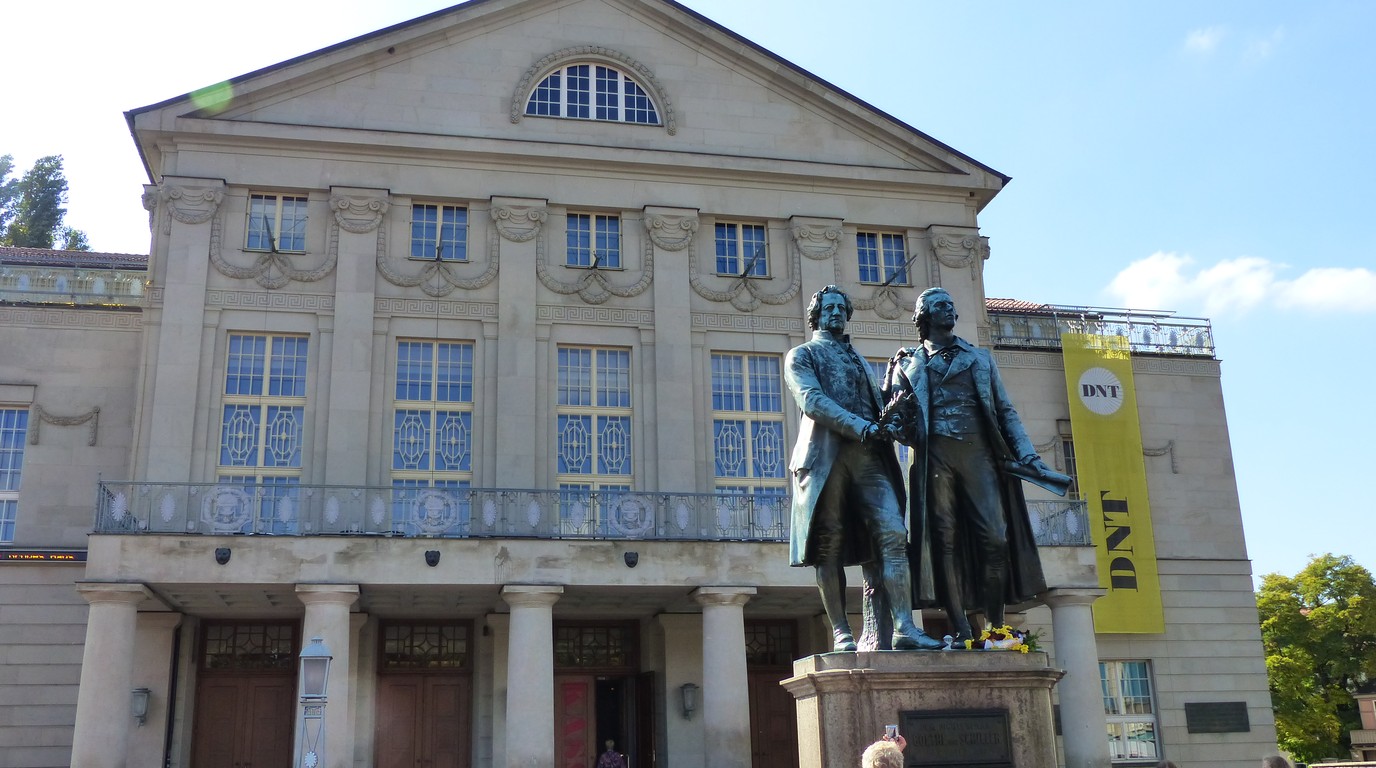
09:00 AM – Theaterplatz & The Classical Monument: Begin your morning at Theaterplatz in front of the German National Theatre (*Deutsches Nationaltheater*). Admire Ernst Rietschel’s monumental 1857 bronze statue depicting Goethe and Schiller sharing a single laurel wreath, marking the birthplace of both German classical literature and the historic Weimar Republic of 1919.
10:30 AM – Goethe National Museum & Goethe’s Residence: Walk to the Frauenplan to tour Goethe’s home, where the poet lived for nearly 50 years until his death in 1832. Walk through eighteen preserved state and private rooms, viewing his 50,000-piece mineral collection, classical Italian art studies, and his austere, book-lined study preserved exactly as he left it.
12:30 PM – Winter Lunch in the Marktplatz: Stroll through the cobbled market lanes to Weimar’s historic Marktplatz. Stop at the mobile charcoal-grill carts for a piping hot Thüringer Rostbratwurst, or sit inside the historic *Gasthaus Zum Weißen Schwan*, where Goethe himself was a regular guest.

02:00 PM – The Duchess Anna Amalia Library (Herzogin Anna Amalia Bibliothek): Enter the breathtaking Rococo Hall (*Rokokosaal*). Admire the three-tiered curving wooden galleries, antique plaster busts, and gilded stucco ceilings holding precious historic volumes that miraculously survived the tragic 2004 fire and were lovingly restored.
04:00 PM – Schiller’s Residence: Walk up Schillerstraße to visit the cheerful yellow house where Friedrich Schiller spent the final fruitful years of his life, penning *William Tell* and *The Bride of Messina*.
07:30 PM – Dinner in an Historic Cellar: Dine inside *Brauhaus Zum Schwarzen Bären* or *Residenz Café*, savoring tender Thuringian Sauerbraten with handmade potato dumplings and a fresh glass of dark unfiltered Köstritzer Schwarzbier.
Day 2: Bauhaus Revolution, Romantic Parklands & Garden Villas
09:30 AM – The Bauhaus Museum Weimar: Start your second morning at the minimalist concrete Bauhaus Museum on Stéphane-Hessel-Platz. Discover the revolutionary early design work of Walter Gropius, Paul Klee, and Wassily Kandinsky from 1919 to 1925 that forever transformed modern industrial design, furniture, and typography.
11:30 AM – Historic Bauhaus University & Van de Velde Building: Walk to Geschwister-Scholl-Straße to tour the main building of the Bauhaus University, designed by Belgian architect Henry van de Velde. Walk up the sweeping sculptural central staircase and view the reconstructed office of Walter Gropius.

01:30 PM – Winter Walk through Park an der Ilm to Goethe’s Garden House: Walk south into the romantic English-style *Park an der Ilm*. Cross the wooden footbridges over the frozen river to *Goethes Gartenhaus*, the secluded country cottage gifted to Goethe by Duke Karl August in 1776 where he wrote *Erlkönig* and portions of *Faust*.
03:30 PM – Franz Liszt House (Liszt-Haus): Visit the 19th-century court gardener’s house where Hungarian virtuoso Franz Liszt spent his summers giving free piano masterclasses to prodigies from across the globe, admiring his original Bechstein grand piano.
07:00 PM – Candlelit Farewell Dinner: Conclude your weekend break at a cozy tavern on the Frauenplan, savoring a warm slice of Weimarer Zwiebelkuchen alongside crisp Saale-Unstrut Silvaner wine.
3 Insider Secrets for Visiting Weimar in Winter
1. Reserve the Anna Amalia Rococo Hall Ahead: To protect the historic wooden floors and microclimate of the Rococo Hall, admissions are limited to small timed groups wearing soft felt overshoes. Always book your ticket online a week in advance!
2. Listen to the Meissen Porcelain Glockenspiel: Pass by the neo-Gothic Town Hall on Marktplatz at 10:00 AM, 12:00 PM, or 3:00 PM to hear the delicate chimes of 35 genuine Meissen white porcelain bells echoing through the winter air.
3. Authentic Charcoal Only: True Thüringer Rostbratwurst is strictly protected by EU law and must be cooked over charcoal (*Holzkohle*) rather than gas. Always look for the glowing charcoal brazier and sizzling sausages turned with long iron tongs!
What to Savor & Historic Gasthäuser
- Gasthaus Zum Weißen Schwan (Frauenplan 2): Operating since 1568 directly opposite Goethe’s house, offering refined Thuringian roast duck, venison ragout, and classic Sauerbraten.
- Brauhaus Zum Schwarzen Bären (Markt 20): Historic beer hall serving hearty regional sausage platters, crispy pork knuckle, and freshly tapped copper-brewed lagers.
- Residenz Café (Grüner Markt 4): Weimar’s oldest traditional coffeehouse, perfect for warming up with artisan plum cake, warm apple strudel, and hot specialty coffee.
- Felsenkeller Weimar (Humboldtstraße 37): Atmospheric vaulted cellar restaurant renowned for oversized authentic Thüringer Klöße and regional craft beers.
Practical Winter Travel Logistics & Getting Around
- Arrival & Transit: Weimar Hauptbahnhof offers direct 15-minute ICE/RE trains to Erfurt, 45-minute trains to Leipzig, and 2-hour high-speed ICE connections to Berlin and Frankfurt.
- Winter Weather: Daytime temperatures in winter typically range from -2°C to 4°C (28°F–39°F). Crisp snowfall transforms the romantic Ilm parklands and classical palaces into a serene winter landscape.
- What to Pack: Warm wool coat, sturdy insulated walking shoes for park paths and cobblestones, and warm gloves for exploring outdoor monument squares.
Where to Stay in Weimar in Winter
- Altstadt (Historic Center): Steps from Theaterplatz, Marktplatz, and Goethe’s residence, ideal for first-time visitors seeking complete walkability.
- Frauenplan Quarter: Romantic cobblestone streets surrounding historic inns and literary heritage museums.
- Park Quarter: Peaceful green avenues bordering Park an der Ilm, perfect for quiet and scenic boutique stays.
Frequently Asked Questions About Weimar in Winter
Is 48 hours enough time to visit Weimar?
Yes, 48 hours is ideal to visit the Goethe and Schiller residences, tour the Anna Amalia Library, explore the Bauhaus Museum, and enjoy relaxed walks through Park an der Ilm.
Are Weimar’s museums open during the winter months?
Yes, all major Klassik Stiftung Weimar museums and Bauhaus sites remain open year-round with standard winter opening hours.
Can I combine Weimar with a visit to Erfurt?
Easily. Direct regional trains run between Weimar and Erfurt every 15 minutes, taking only 14 minutes, making a combined weekend itinerary seamless.
Save This Weimar Winter Itinerary on Pinterest
Planning your winter weekend escape to Germany’s city of poets and thinkers? Pin this complete 48-hour Weimar travel guide to your Pinterest boards for fast access to Goethe sights, Bauhaus design, and historic dining tips!

Leave a Comment